Split Mandala Monochrome Coloring Pages — The Style Trending on PromptBase Right Now
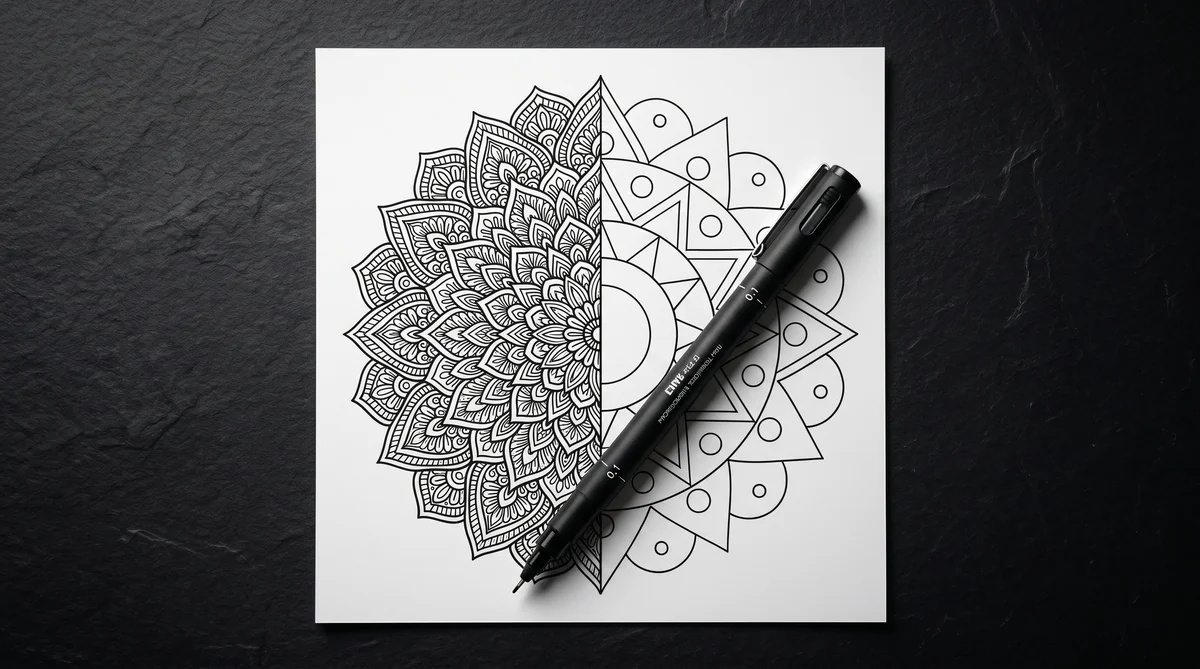
Split mandala is one of those styles where the concept is immediately obvious and immediately striking — a circular mandala design divided down the center, each half rendered in a contrasting approach. One side ornate and detailed, the other minimal and geometric. One side floral, the other architectural. One side dense black pattern on white ground, the other inverted. The visual tension between the two halves is exactly what makes it compelling — both to look at and to color.
As of May 2026, split mandala monochrome is the top trending prompt style on PromptBase by monthly views. If you're building a coloring book product line, this is the category to move on now — before the search terms get crowded and the market fills in.
🔲 What Is Split Mandala Monochrome?
A split mandala breaks the traditional full-circle symmetry in two ways:
- The split — the design is divided along a central axis (vertical, horizontal, or diagonal), with each half drawn in a visually distinct style
- The monochrome constraint — the design is built for single-color or high-contrast coloring, rather than the multi-color fill approach of traditional mandalas
The result is a page that can be colored with a single marker, a single ink, or even a single pencil — and still look finished and intentional. This is a different buyer psychology than a standard coloring book: the colorist isn't choosing colors, they're choosing pressure, texture, and coverage. It's meditative in a different way.
The most popular split combinations:
- Ornate / Minimal — one half filled with floral and botanical detail, the other reduced to clean geometric shapes
- Dark / Light inversion — one half is dense black pattern with white cutouts, the other is white space with black outline — the same design, mirrored in tone
- Floral / Geometric — organic natural forms on one side, hard angles and tessellation on the other
- Fine line / Bold — intricate thin-line work on one half, thick bold strokes on the other — two difficulty levels in a single page
📈 Why It's Trending Now
The style has momentum for specific reasons worth understanding before the window closes:
Pinterest virality. Split mandala images have extremely high save rates on Pinterest because of the visual contrast — a single image communicates two styles simultaneously. That makes them better pins than standard mandalas, which means more organic discovery for listings that use them as product photos.
Low existing supply. On Amazon KDP and Etsy, split mandala coloring books are still a small category. Most sellers haven't caught up to the search demand yet. The gap between what buyers are searching for and what's currently available is the window.
AI as natural fit. Split mandala is surprisingly well-suited to AI generation — the two-half structure gives a prompt a clear compositional rule to follow, and the monochrome constraint removes the color inconsistency problem that plagues more complex generated designs. With the right prompt, output is more reliable than with most other coloring page categories.
⚠️ The AI Challenge with Split Designs
Split mandala is a style where prompt quality matters more than average. The failure modes are specific:
- Inconsistent weight across halves — the left side renders with thick lines, the right with thin ones. Without explicit prompt control, the AI treats each half as a separate visual decision rather than a unified design
- Symmetry bleed — the AI "corrects" toward full symmetry and softens the contrast between halves, producing a mandala that's almost split rather than deliberately divided
- Gray fill in the dense half — the ornate or dark side of the design often collapses into shading rather than maintaining pure black areas with clear coloring regions
- Inconsistency across a set — generating 20 pages that feel like the same product requires consistent prompt control. Without it, you get 20 good individual images that don't work as a collection
All of these are solvable with the right prompt — and harder to fix without one. A well-engineered split mandala prompt specifies the division rule, the contrast logic, the line weight behavior on each half, and the monochrome output constraints simultaneously.
✏️ Where Your Work Begins — The Artist's Role
Even with reliable prompt output, the coloring pages don't sell themselves. What turns a generated split mandala into a product buyers choose is everything the creator brings to the editing and curation process.
The split mandala format is particularly sensitive to post-processing decisions:
- The dividing line — the axis between the two halves needs to read as intentional, not accidental. In Canva, Affinity Designer, or Illustrator, you can clean and sharpen this division in a few minutes per page. That edge is the visual anchor of the entire design.
- Contrast calibration — the dense half needs to be genuinely dark (pure black areas), and the open half genuinely light (clean outlines on white ground). The AI often produces something in between. Adjusting levels in Photoshop or Affinity Photo takes thirty seconds and makes the design work the way it should.
- Set coherence — a split mandala coloring book is only as strong as the consistent logic across all 20–30 pages. Each page should feel like it belongs in the same visual system — same split axis, same line weight logic, same density balance. That editorial judgment is yours. The AI generates each page in isolation; you see the full set.
- Variation strategy — across a set, decide consciously how to vary the designs: same split style with different botanical subjects; same subjects with alternating split directions; a gradient from minimal to dense across the book. These are creative decisions that require a human eye.
Tools that work well for this category: Affinity Designer for vector cleanup and sharpening the split axis; Adobe Photoshop for levels and contrast control; Canva (free) for quick background cleanup and PDF export; Procreate for adding hand-drawn flourishes to the transition zone between halves.
Etsy buyers shopping for a mandala coloring book aren't thinking about how it was made. They're looking at the thumbnail and asking: does this look finished? Does it feel designed? Does it come from a creator with aesthetic taste? That answer comes from your editing decisions, not from the AI output alone.
📦 How to Build a Split Mandala Product Line
The style has enough internal variation to support multiple distinct products:
- The Core Set — 25 split mandala monochrome pages with consistent style. Your base product. Price it at $4.99–$6.99 as a digital download on Etsy, or compile it as a KDP paperback at 8.5×8.5" for Amazon.
- Themed Variations — split floral/geometric (botanical vs. architectural), split seasons (floral summer half / bare winter half), split elements (earth/water, fire/air). Each variation is a separate listing with its own SEO keyword and its own cover image.
- Single-Color Art Prints — position some pages not as coloring pages but as printable art — designs meant to be filled completely with one color (navy, sage, terracotta) and displayed. Different buyer, different price point ($6.99–$9.99).
- KDP Interior Pages — split mandala designs work as interior pages for journals, planners, and mindfulness books. The monochrome format is ideal for black-and-white interior printing. One set of generated images can serve multiple KDP titles.
🏷️ Etsy Listing Strategy for This Style
Split mandala is still building its own search vocabulary, which means you have room to define the category before competitors arrive.
Lead with the visual split in your thumbnail. The contrast between the two halves is the strongest argument for the product. Don't use a cropped detail — show the full circle so the split is obvious at thumbnail size.
Describe the coloring experience, not the technique. "A two-style mandala you color with one pen" is more compelling than "monochrome split mandala design." The buyer wants to know what they're getting to do, not what technical category it belongs to.
Name the contrast in your tags. Use terms like: split mandala coloring page, monochrome mandala printable, black and white mandala pdf, half and half mandala, two-style mandala coloring, contrast mandala art. These are longer-tail terms with lower competition than "mandala coloring page" and more specific search intent.
Know your buyer. They're not the person who wants to relax with any mandala — they want the visual interest of the two-half format specifically. Write to someone who finds traditional symmetrical mandalas a little predictable and wants more tension in the design.
This is the prompt I use for split mandala output — tested for clean monochrome lines, consistent split logic, and reliable results across a full set of pages.
Split Mandala Monochrome Coloring Pages — PromptBase →Final Thoughts
Split mandala monochrome works visually, sells in an underserved niche, and is well-matched to what AI generation does reliably. The trend window is open. The prompt exists. The gap is in execution — the editing, the curation, the listing strategy, the product lineup decisions that only a creator makes.
That's where the business is. The AI handles the outline. You handle the product.
👉 Browse the full prompt collection →