How to Build a Clipart Business on Etsy Using AI
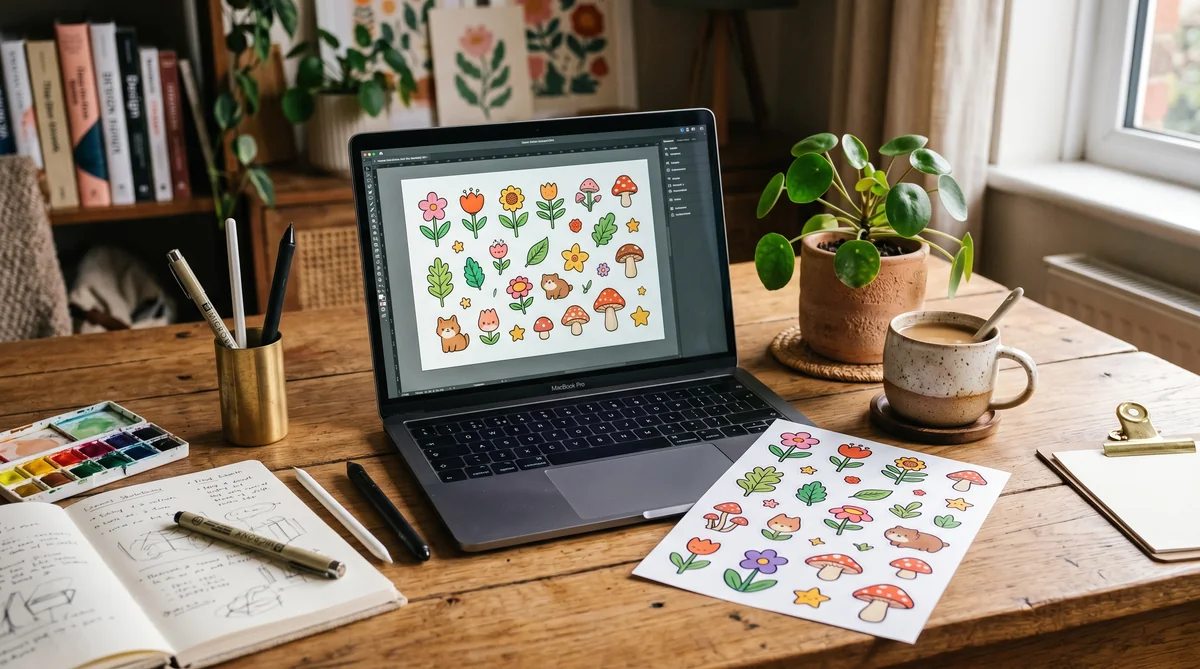
Clipart is one of the most sustainable digital product categories on Etsy — not because it's easy, but because the economics are genuinely good. A single themed clipart set sells repeatedly without restocking, shipping, or customer service. Buyers purchase bundles, return for seasonal releases, and pay a premium for commercial license rights. The income is passive in the real sense of the word.
AI changes the starting point of this business. What previously required weeks of illustration work — building a cohesive set of 20–30 elements in a consistent style — can now be generated in hours. That doesn't make the business easier. It makes the bottleneck shift from production to judgment: niche selection, aesthetic consistency, post-processing quality, and Etsy positioning.
This is how to build a clipart business on Etsy using AI prompts — from niche selection to first listing.
🎨 Why Clipart Works as a Business Model
Most digital product categories on Etsy have one sale per buyer. Clipart is different. Buyers purchase sets — 20 to 50 PNG elements in a consistent style — and return for more when you release new themes. A customer who buys your gothic botanical set in October will come back for your gothic floral set in spring. That repeat buyer behavior is what makes clipart a compounding catalog rather than a one-time transaction.
The commercial license premium is the second advantage. Buyers who want to use your clipart in products they sell — stickers, mugs, shirts — pay more. $8–$15 is normal for a commercial license clipart set, versus $3–$5 for personal use. That buyer is motivated and low-refund: they've already decided to build a product line and they need the assets.
Seasonality gives the business natural release cadence without forcing it. Halloween in August. Christmas in October. Valentine's in December. Each seasonal release is its own listing with its own traffic spike, and the catalog grows with each cycle.
🤖 What AI Changes — and What It Doesn't
AI handles the mechanical generation of individual elements. A prompt that produces consistent kawaii characters, consistent gothic botanical motifs, or consistent cozy cottage elements across 30 images is genuinely valuable — it replaces weeks of repetitive drawing with hours of directed generation and editing.
What AI doesn't change: the decisions that determine whether a clipart business works.
- Niche selection — which aesthetic, which sub-market, which buyer
- Style coherence — whether 30 generated images feel like one designer's work
- Post-processing quality — clean backgrounds, consistent sizing, export standards
- Listing positioning — thumbnail strategy, keyword research, bundle construction
The AI generates the raw material. The business decisions, the editorial eye, the quality control — those remain entirely yours. Etsy buyers don't choose a small shop because of how its products were made. They choose it because of how the products look and feel.
🎯 Choosing Your Niche
Specificity is the single most important decision in a clipart business. "Cute animals" is a category. "Cozy witch cottage elements in an autumn kawaii style" is a niche. The difference in Etsy search performance, repeat buyer loyalty, and product coherence is enormous.
The niches that work best for AI-assisted clipart in 2026 share three properties: strong visual identity (buyers recognize the aesthetic immediately), underserved supply (more search demand than existing listings), and repeat purchase potential (seasonal or thematic variations are natural).
Current niches with strong opportunity:
🖌️ The Workflow: Prompt to PNG Bundle
The workflow for turning a clipart prompt into a sellable Etsy product has five stages. Each one is yours — the AI is only present in the first.
- Generate at high resolution — aim for at least 2000×2000px per element. This gives you headroom to crop, adjust, and export at multiple sizes without quality loss.
- Remove backgrounds — Canva's background remover (free), Adobe Firefly, or Photoshop's object selection tool. Every element needs a clean transparent PNG background before bundling.
- Consistency pass — open all 20–30 elements side by side and compare. Do they feel like they came from the same designer? Adjust color temperature, line weight, or composition outliers that break the set's cohesion.
- Standardize sizing and export — 300 DPI, transparent PNG, consistent canvas size (3000×3000px is standard for commercial clipart). Canva, Affinity Designer, or Illustrator for final export.
- Bundle and name files — include a usage terms document. Name files consistently (set-name-element-01.png). Zip into a single download file.
Tools that matter at this stage: Canva (free, sufficient for background removal and basic adjustment), Affinity Designer (one-time purchase, professional vector editing for resizing and cleanup), Adobe Photoshop (industry standard, worth it if you're building volume), Procreate for adding hand-drawn finishing touches that give AI-generated elements a personal mark.
📦 Building a Product Line
A single clipart set is a product. A series of thematically related sets is a business.
The product line structure that works best:
- Core evergreen set — your primary aesthetic, 25–30 elements, commercial license. This is the set you iterate first, price at $9.99–$14.99 for commercial, and use as the anchor for your shop's identity.
- Seasonal variations — the same aesthetic applied to seasonal themes. Gothic kawaii autumn → gothic kawaii winter → gothic kawaii spring. Each variation is its own listing with seasonal search traffic.
- Sub-element sets — smaller focused sets (botanical elements only, character set only, background scenes only) at lower price points that upsell the full bundle. These expand your listing count from a single generation session.
- Bundle listings — aggregate your sets into a discounted mega-bundle. Buyers who've purchased one set will upgrade to the bundle. Bundle listings also rank for broader keyword terms.
🏷️ Etsy Listing Strategy for Clipart
Clipart search on Etsy is keyword-driven and highly specific. The buyer knows exactly what they want before they search. Your listing needs to match that specificity.
Lead with use case in your title. "Gothic Kawaii Spring Clipart PNG — Commercial Use, Transparent Background, Spooky Cute Elements" tells the buyer everything they need to know: the aesthetic, the format, the license, and the character of the set. Generic titles like "Cute Clipart Set" are invisible.
Thumbnail strategy: Show multiple elements arranged together — not a single character in isolation. The arrangement communicates cohesion and quantity, which are the two things clipart buyers evaluate first. A flat lay of 6–8 elements on a white or soft-colored background outperforms a single character shot every time.
License clarity in the description. State explicitly: personal use vs. commercial use, whether buyers can use in products they sell, whether resale of the original files is prohibited. Ambiguity creates refund requests. Clarity builds trust.
Keyword targets for the long tail: [aesthetic] clipart png, [aesthetic] clipart transparent background, [aesthetic] clipart commercial use, [aesthetic] digital stickers, [aesthetic] printable elements. The more specific, the better the conversion rate from the search session.
✏️ The Artist's Role — Why This Isn't Just Automation
The clipart business works because of what you bring to it, not because of what the AI generates.
Etsy buyers who choose a small independent creator over a mass-content shop are making an emotional decision. They trust the person's taste. They want the set to feel like it was designed by someone with a genuine aesthetic point of view — not assembled from generic outputs.
That trust comes from the consistency pass you run across 30 elements. The color palette decision you make. The three elements you cut because they didn't feel right. The thumbnail you styled to communicate the set's personality at 150 pixels wide. None of that is in the prompt. All of it is yours.
The AI generates the starting point. Your eye, your editing, your aesthetic judgment is what makes the set worth $12.99 instead of $1.99.
These are the prompts I use to generate clipart sets for my own catalog — tested for consistent output across a full batch, style-coherent elements, and PNG-ready results.
Cozy Witch Cottage Clipart — PromptBase →Gothic Cute Spring Kawaii Clipart — PromptBase →
Final Thoughts
A clipart business on Etsy is a real business — not a side project. Repeat buyers, commercial license premium, seasonal release cadence, compounding catalog. The economics work.
AI makes the production side faster. It doesn't make the business decisions for you. Niche selection, style coherence, listing quality, and the editorial judgment that separates a cohesive designer's set from generic AI output — that's the business you're building.
The prompts exist. The niches have room. The catalog builds with each release.
👉 Browse the full prompt collection →